
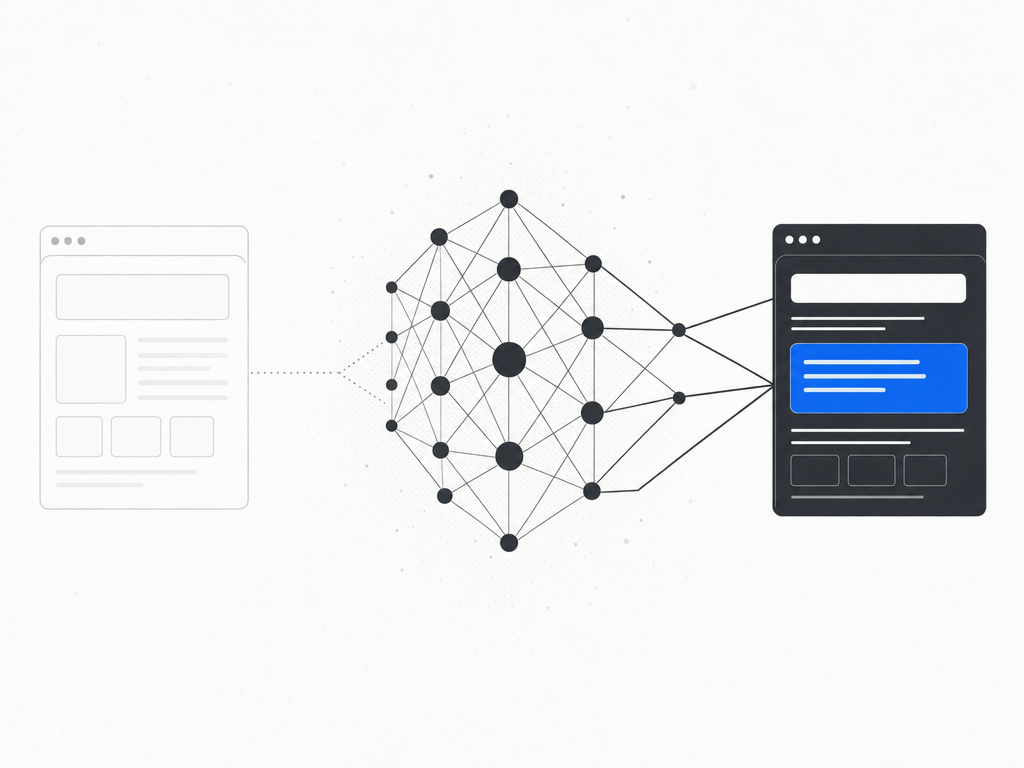
A prospect just asked ChatGPT. Your business was not in the answer.
Answer Engine Optimization (AEO) is the practice of making a website readable, retrievable, and recommendable by AI tools like ChatGPT, Gemini, and Google AI Overviews. AEO is not SEO with FAQ schema glued on; it is a distinct discipline because AI engines synthesize answers instead of ranking lists. That position comes from Digital Delights' pattern across 200+ optimized sites.
Picture it concretely: a prospect opens ChatGPT and types "best physiotherapy clinic near me for sports injuries." The AI names three clinics. Yours is not one of them, even though you rank on page one of Google. That gap is what AEO exists to close.
What AEO actually is (and the version that is not AEO)
AEO is designing a website so AI engines can read it, pull the right facts out of it, and name your business when someone asks a relevant question. The common industry shorthand is that "AEO is just SEO with FAQ schema." We reject that outright. Bolting a FAQ block and some FAQPage markup onto an SEO page does not make it AEO, and treating it as the finish line is where most AEO checklists go wrong.
Here is the plain-English version. SEO is about earning a position in a ranked list of blue links. AEO is about becoming a source an AI trusts enough to quote directly in a generated answer. Those are different outcomes that require different work. A page can win the first and lose the second entirely. FAQ schema helps a machine parse a question-and-answer pair; it does nothing on its own to make your business the entity an AI pulls forward when it synthesizes a recommendation. The schema is a single signal, not the strategy.
Why AI search works differently from Google search
AI search works differently because it does not hand you a list and let you choose; it reads many sources, synthesizes one answer, and names a few businesses inside it. Google's classic job was to rank ten links and trust you to click. In 2025, consumers increasingly skip that step. They ask ChatGPT, Gemini, or Google AI Overviews a direct question and accept the synthesized answer that comes back.
That changes the physics of visibility. On Google, ranking fourth still earns clicks. In an AI answer, if you are not one of the handful of businesses named, you do not exist for that query. There is no page two to drift onto. A website built purely on SEO logic (keyword targeting, backlinks, title tags) can rank beautifully and still be structurally invisible when an AI composes its answer, because the AI is not reading a ranked list. It is retrieving facts and reassembling them.
How AI engines decide what to recommend
AI engines decide what to recommend by retrieving content from across the web and synthesizing it into an answer, rather than pointing to a ranked list of pages. The observable behavior and public documentation of Google AI Overviews, ChatGPT, and Gemini point to the same structural pattern: these systems pull facts, entities, and claims from sources they can parse clearly, then assemble a response that names specific businesses. When a site lacks structured retrieval signals, the engine has nothing clean to extract, so it reaches for a competitor whose content it can read.
This is why clarity of facts matters here. An AI needs to understand who you are, what you do, who you serve, and where. Several signals feed that understanding: entity clarity, content that answers real questions in extractable form, consistent business information across the web, and structured data that confirms rather than decorates. Each of these contributes through its own mechanism. We are not ranking them against each other, because operator reality does not support one tidy hierarchy. In the absence of AI-ready content design, even a high-ranking page gives the engine little to work with. If you want the deeper breakdown of how these retrieval signals operate, our guide to how AI tools pick which businesses to recommend covers it piece by piece.
Signs your business is already invisible to AI tools
One sign your business is invisible to AI tools is simple: ask the AI a question your ideal customer would ask, and see whether you appear. If ChatGPT or Gemini names competitors and skips you on a query you should obviously win, you have your answer. No dashboard required.
Other signs show up in the structure of the site itself. Your content is written as marketing copy rather than as direct answers to real questions. Your business facts (services, locations, specialties) are scattered or inconsistent across your site and the directories where buyers verify you. Your pages carry keywords but no clean, extractable statements an AI can lift. When a site lacks these retrieval-friendly signals, AI engines pass over it even while Google still ranks it. For help recognizing the full set of warning signs, our walkthrough of AEO invisibility signals covers them in order.
Can an existing website be made AEO-ready, or does it need a rebuild
An existing website can be made AEO-ready without a full rebuild when the underlying site is crawlable, editable, and organized enough to support answer-focused content and entity clarity. The decision depends on what is already there. If your site has a reasonable technical foundation and real content, the job is reshaping that content into extractable answers, fixing entity consistency, and adding structured data that confirms your facts. That is retrofitting, and it is a defined scope of work rather than a rebuild.
A rebuild becomes the sensible path when the underlying structure actively fights retrieval: thin content, broken information architecture, or a platform that makes clean markup impossible. The honest way to know which camp you are in is a diagnosis, not a guess. A proper AEO audit checks whether AI engines can read, retrieve, and recommend your pages, and tells you whether optimizing or rebuilding is the better spend. Our breakdown of what an AEO website audit examines explains exactly what that audit covers and how the rebuild-versus-optimize call gets made.
What results to expect and on what timeline
Expect AI visibility shifts on a timeline of weeks, not days, once AEO work is in place. Our client work shows a typical results window of 4 to 8 weeks, with an average AEO score of 93% on the sites we optimize. We are deliberately not promising a ranking, a traffic number, or a guaranteed spot in any AI answer, because no honest operator can guarantee what a synthesis engine will say. What we can describe is the mechanism: when a site gains structured retrieval signals and extractable content, AI engines have something clean to pull, and the probability of being named rises.
Visibility is only half the value. When an AI referral sends someone to your site, the next job is converting that visitor before they bounce back to the AI. That is where an on-site assistant earns its keep, and our guide to AI chatbots that capture leads 24/7 covers how to catch those visitors without adding staff. A business that waits another year is not holding steady; it is letting competitors become the default answer while AI search becomes the default habit.
The one thing to do this week
Do this one thing this week: open ChatGPT or Gemini, type the exact question your best customer would ask to find a business like yours, and read the answer closely. Note which businesses get named and whether yours is among them. Run it two or three times with slightly different wording. If you are absent across all of them, you now have direct evidence that your SEO is working on Google while your AEO is not working anywhere an AI answers.
That single test tells you more than any theory about AI search. If the result stings and you want a concrete diagnosis of why the AI skipped you, Claim My Free Audit and we will show you what the engines can and cannot read on your site.
Frequently asked questions
How is AEO different from SEO in practice, not just in definition?
In practice, SEO work earns you a position in a ranked list of links, while AEO work makes you a source an AI quotes inside a synthesized answer. The day-to-day tasks differ: SEO leans on keywords, backlinks, and page ranking signals, whereas AEO focuses on extractable answers, entity clarity, and structured data that confirms your facts. A page can rank well on Google and still never appear when ChatGPT or Gemini composes a recommendation, because the engine is reading facts, not a list.
Why are customers asking ChatGPT and Gemini instead of Googling?
Because they get one direct answer instead of ten links to sift through. In 2025, tools like ChatGPT, Gemini, and Google AI Overviews have become default research habits for many consumers who want a recommendation, not a research project. They ask a plain question and accept the synthesized response. For businesses, that shifts the stakes: if an AI does not name you inside its answer, there is no second page to drift onto and no link for the customer to scroll toward.
Why does ChatGPT not mention my business?
ChatGPT does not mention your business when it cannot cleanly read who you are, what you do, and who you serve from the sources it retrieves. If your content is written as marketing copy rather than as direct, extractable answers, or if your business facts are inconsistent across your site and profiles, the engine has little to pull forward. It then reaches for a competitor whose content it can parse. Ranking on Google does not fix this, because the AI is not reading Google's ranked list to build its answer.
What kinds of content and website structures do AI engines actually cite?
AI engines cite content that states facts clearly and answers real questions in extractable form. That includes direct question-and-answer content, clear statements about your services, locations, and specialties, consistent business information across the web, and structured data that confirms those facts rather than just decorating the page. Each of these contributes through its own mechanism, so no single one is a silver bullet. FAQ schema on its own does not qualify a page as AEO-ready; it is one signal among several, not the strategy.
Can an existing website be made AEO-ready, or does it need a rebuild?
An existing website can be made AEO-ready without a full rebuild when the underlying site is crawlable, editable, and organized enough to support answer-focused content. The work is restructuring content into extractable answers, fixing entity consistency, and adding confirming structured data. A rebuild becomes sensible when the underlying structure actively blocks retrieval: thin content, broken architecture, or a platform that prevents clean markup. The reliable way to know which path fits is an AEO audit that checks whether engines can read, retrieve, and recommend your pages.
How long does it take to see results after implementing AEO?
Expect results in weeks rather than days. Our own client work shows a typical window of 4 to 8 weeks once AEO work is in place, with an average AEO score of 93% on the sites we optimize. We do not promise a specific ranking or a guaranteed spot in any AI answer, because no one can guarantee what a synthesis engine will say. What improves is the mechanism: structured, extractable content gives AI engines something clean to pull, which raises the chance of being named.